Tag Archives: ai

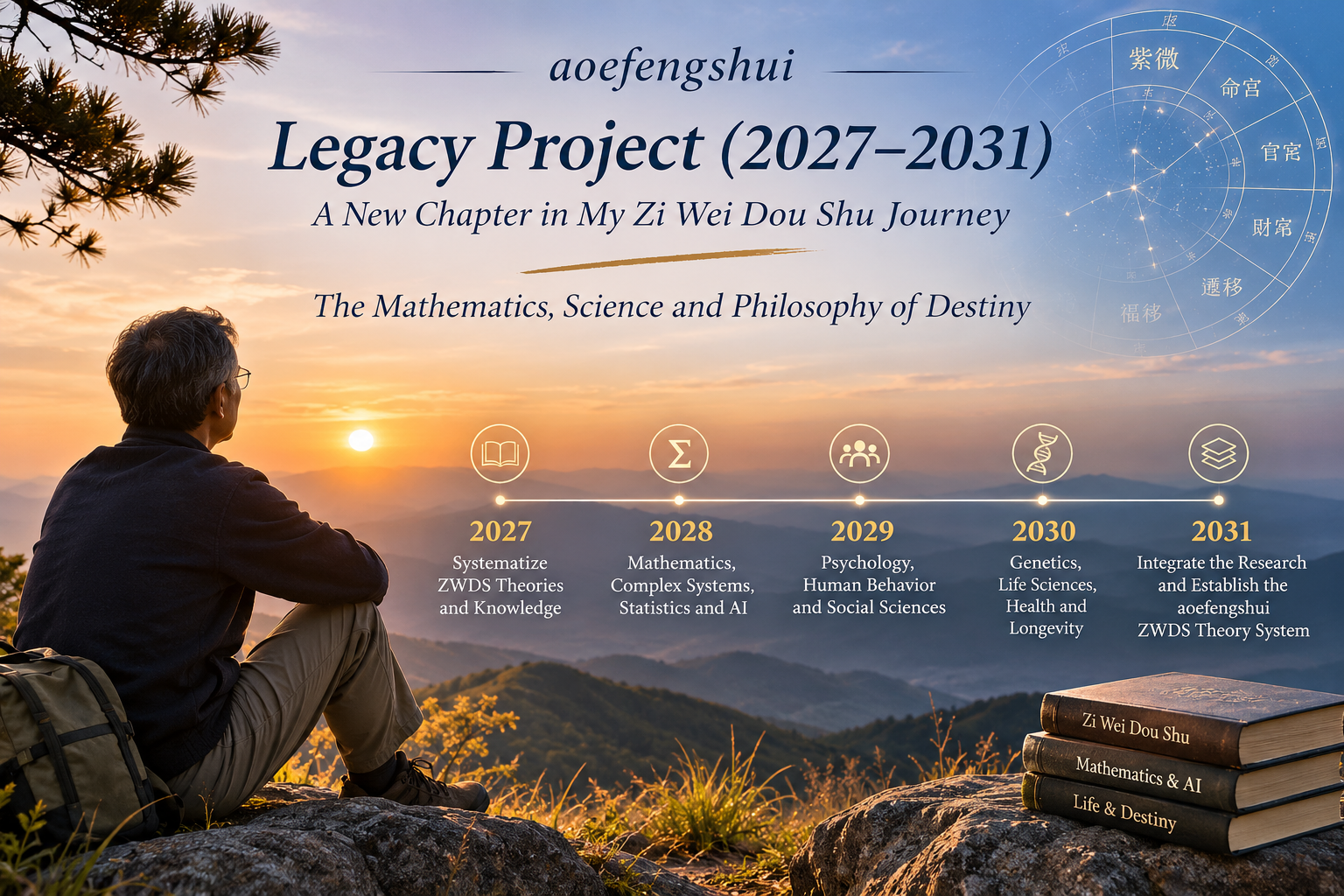
aoefengshui Legacy Project (2027–2031): A New Chapter in My Zi Wei Dou Shu Journey

I turned 60 this year.

Over the past two decades, Zi Wei Dou Shu (ZWDS) has been an important part of my life. Although I have almost retired from providing ZWDS consultations, my interest in ZWDS research has never diminished.

Since 2015, I have developed nine ZWDS courses, gradually extending my research into Karma, Depression and Autism, the Stock Market, He-Tu/Luo-Shu, Traditional Chinese Medicine, and Lifespan.

However, there are still many questions that I would like to explore.

What is the underlying logic of ZWDS? Can its complex structures be expressed mathematically? Is there a deeper relationship between time, human life, and destiny? And how far can AI help us in this exploration?

I have therefore decided to dedicate the next five years (2027–2031) to a new research project:

The aoefengshui Legacy Project — The Mathematics, Science and Philosophy of Destiny.

My Five-Year Research Plan

  • 2027: Systematizing the existing aoefengshui ZWDS theories, knowledge, and interpretation rules.
  • 2028: Exploring mathematics, complex systems, statistics, and AI applications in ZWDS.
  • 2029: Extending ZWDS research into psychology, human behavior, and social sciences.
  • 2030: Further exploring genetics, life sciences, health, and longevity.
  • 2031: Integrating the research findings and establishing the aoefengshui Zi Wei Dou Shu Theory System.

I hope to eventually bring together my research in the form of a comprehensive book, a digital knowledge base, a research database, and a ZWDS AI system.

The purpose of this project is not to prove that ZWDS is always right. Some of my existing theories may need to be revised, and some of my new ideas may not stand up to scientific examination. I am quite comfortable with that. There is little point in research if we already believe we know all the answers.

Why Am I Doing This at 60?

At this stage of my life, I have the freedom to spend my time doing something that genuinely interests me.

I am fortunate to have accumulated nearly two decades of ZWDS knowledge and experience, and to be living in an era when AI is opening up new possibilities for research.

If, by the age of 65, I can leave behind a systematic body of ZWDS knowledge that others can study, question, improve, and further develop, I will consider these five years very well spent.

There is still so much to learn and so much that I do not understand.

Perhaps this is what makes the journey interesting.

At 60, I am not looking for another career. I am simply looking forward to another five years of discovery.

Stay curious. Think independently. Keep exploring.
Zi Wei Dou Shu and Longevity Modeling — A New Perspective on Health Prediction

In an era of rapid advances in medicine and artificial intelligence, our understanding of “longevity” is evolving. Traditionally, lifespan was seen as fate—unpredictable and uncontrollable. But within the framework of Zi Wei Dou Shu, longevity becomes a structure of time that can be observed, interpreted, and even optimized.

The Natal Chart as a Philosophical Map of Time

Zi Wei Dou Shu constructs a natal chart based on birth time, composed of stars and palatial sectors. This chart reflects not only personality traits and behavioral tendencies, but also the trajectory of health, vitality, and lifespan—through structures like the Life Palace, Health Palace, and Happiness Palace.

We treat Zi Wei Dou Shu as a philosophical system of temporal modeling. It is not superstition—it is a logic of life unfolding.

From Symbolism to Modeling — Visualizing Longevity Through Data

We are conducting an experimental study to translate Zi Wei Dou Shu charts into structured data and apply AI-based time-series analysis to explore longevity prediction.

Preliminary findings suggest meaningful correlations between certain star configurations and health outcomes, especially in:

  • Autism spectrum traits
  • Depressive tendencies
  • Longevity potential

This is not fortune-telling—it is a fusion of philosophy and data, offering a new way to understand health and lifespan.

Global Research Projects — Exploring Longevity Through AI and Symbolic Systems

Across the world, institutions are exploring how artificial intelligence and symbolic modeling can help us understand lifespan. These projects offer inspiration and validation for metaphysical approaches:

Northeastern University – Professor Tina Eliassi-Rad
Treats life as a sequence of events—education, income, health—encoded as vectors to predict personality and mortality.

Bielefeld University – Lifespan Prediction from Images
Uses visual transformer models to estimate remaining lifespan from facial and full-body images, with uncertainty quantification.

MIT – CBMM (Center for Brains, Minds and Machines)
Explores cognitive architectures and symbolic reasoning for modeling lifespan.

Stanford University – HAI (Human-Centered AI Institute)
Focuses on personalized health prediction and ethical AI, including mental health and aging.

University of Toronto – Vector Institute
Applies deep learning to survival analysis and individualized health trajectories.

These projects reflect a growing interest in combining symbolic systems, health data, and AI—not just biologically, but philosophically.

Why Longevity Modeling Matters

Western medicine relies on genetics, lifestyle, and environment to predict lifespan. Zi Wei Dou Shu offers a temporal-symbolic model of individual variation, based not on averages but on unique chart structures.

What’s Next:Building a Longevity Visualization Platform

We are developing a prototype system that merges Zi Wei Dou Shu charts with health data to generate personalized longevity insights.

The platform will offer:

  • Structural chart analysis with health risk indicators
  • Visual mapping of longevity potential
  • Philosophical interpretation and behavioral guidance

This is more than a tool—it is a new way to understand life, time, and destiny.

We believe metaphysics is not a relic of the past—it is a philosophy for the future. Longevity modeling is our first step toward a more interpretable destiny and a more optimizable life.

Visit us: aoefengshui.ai